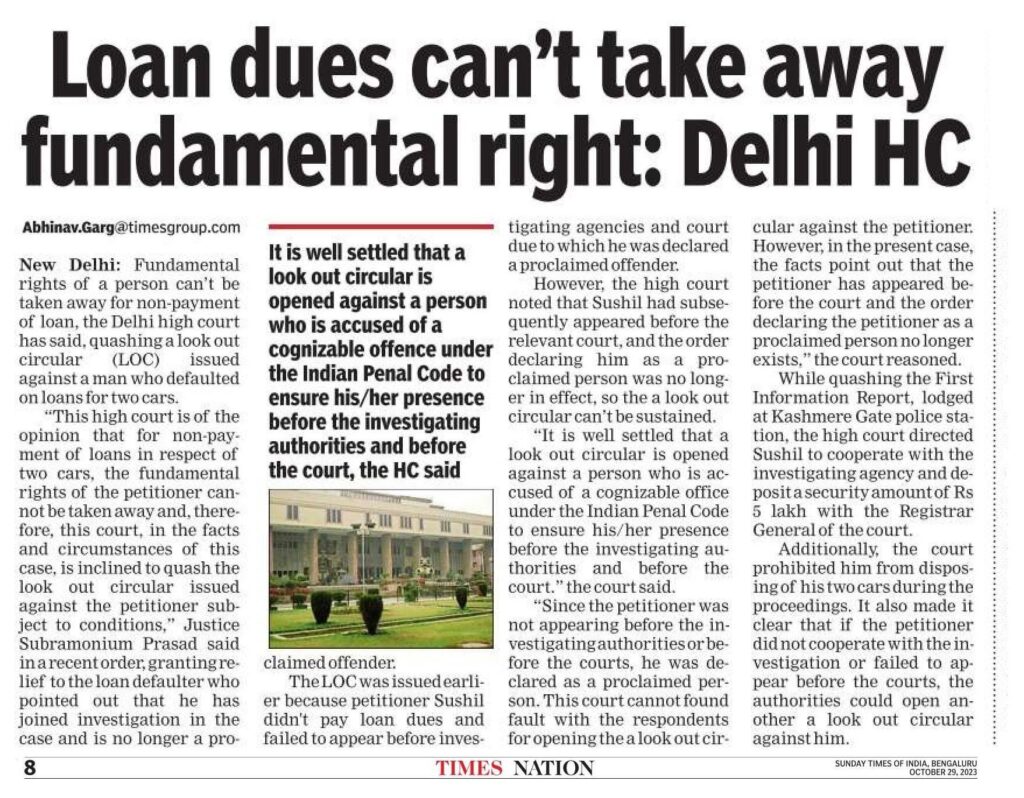
Delhi HC Justice Subramonium Prasad’s ruling in the matter of W.P.(C) 9489/2023 and CM APPLs. 38040/2023 and 44318/2023 has stirred a complex debate, raising concerns about the intricate balance between the fundamental rights of borrowers and the interests of depositors, as well as the overarching stability of the economy.
A striking concern emerges from the perceived emphasis on borrowers’ rights over depositors’ interests. It’s contended that depositors, often ordinary individuals relying on financial institutions to safeguard their hard-earned savings (HEM), bear the brunt of defaults. When borrowers fail to meet their obligations, depositors face financial instability, impacting their lives and eroding trust in the financial system. When a borrower defaults on a loan, it is not just the financial institution that suffers; depositors, who have entrusted their HEM to the financial institution, are also at stake. Most depositors are ordinary individuals who choose to trust financial institutions to save their entire lifetime earnings and whose livelihood depends solely on these savings. If financial institutions are unable to recover loan dues, they will obviously default on their own obligations to depositors, leading to widespread financial instability. Defaults to pay interest and repay principal investments will certainly disturb peace and disrupt the lifestyle of the depositors and their dependent families. This will cause severe financial distress for depositors, as well as a loss of confidence in the financial system.
A critical apprehension of this ruling is its failure to appreciate depositors’ interests while liberally squandering rights to borrowers. The consequences of such leniency towards defaulters would encourage further defaults, promote risky financial behavior, and encourage fraudulent activities. This will deteriorate lending quality, causing financial losses for both institutions and depositors, thereby undermining the credibility of financial entities and impacting the broader economy. Moreover, the ruling’s implications for economic growth are concerning, making debt recovery more challenging and affecting the credibility of lending institutions, thereby burdening the overall economy.
The opinion in this ruling that the fundamental rights of dishonest defaulters be honored while the interests of honest depositors continue to suffer is a hasty plunder of natural justice principles. Thus, it raises concerns about the potential for moral hazard. This ruling’s precedent-setting nature, potentially encouraging more borrowers to default on dues, fostering risky financial behavior, and encouraging fraudulent activities, are of serious concern. Most borrowers would claim that they cannot be held accountable for defaulting on their borrowings; as a result, they will be more likely to incur risky debt or even engage in fraudulent activities. This, in turn, will degrade lending quality, causing financial losses for both financial institutions and depositors, thereby undermining the credibility of financial institutions and impacting the broader economy. Moreover, there are also concerns about this ruling’s implications for economic growth. This ruling makes debt recovery more challenging, undermines the credibility of lending financial institutions, and dents a burden on the overall economy. Financial institutions that are essential for providing credit to businesses and individuals will henceforth become cautious about lending, leading to a credit crunch that stifles economic progress.
Criticism also extends to the ruling’s failure to adequately consider the interests of all stakeholders, particularly the most vulnerable depositors and the overall economy in the wider public interest. This lack of a comprehensive approach in considering the vulnerable state of depositors, the credibility of financial institutions, and the broader economy raises questions about the ruling’s impact on the Indian judicial system’s integrity. Overall, the Delhi High Court’s ruling is a setback for depositors with negative consequences for the financial system. Around 42 crore victims are estimated to be suffering due to economic offenses stemming from fraudulent loans in financial institutions across the country.
Hence, upholding fundamental rights is crucial, and it is equally important to ensure that the interests and rights of honest individuals are not compromised for dishonesty’s sake. It is therefore important to strike a delicate balance between the fundamental rights of borrowers and depositors, protecting the interests of all stakeholders involved. On the one hand, borrowers should have the right to defend themselves against unfair lending practices or other abuses. On the other hand, depositors should have the right to expect that financial institutions will be able to meet their obligations.
Instead, a more balanced perspective would have upheld borrowers’ fundamental rights while ensuring robust protection for depositors. This balance can be achieved by reinforcing the regulatory framework governing financial institutions, mandating institutions to maintain higher capital buffers, conducting rigorous due diligence, and ensuring effective legal remedies for borrowers, all without compromising the depositor’s interests. Making deposit insurance and credit guarantee policies mandatory for financial institutions will at least ensure fair compensation for depositors affected by institutional failures.
In essence, the debate underscores the need for thoughtful equilibrium, safeguarding borrower’s rights while ensuring depositor’s protection, and maintaining overall economic stability. Addressing the root causes of loan defaults and implementing proactive measures are crucial steps in ensuring the financial system’s integrity and the well-being of all stakeholders involved.